Under My Bed
April 1st, 2013
First printed in Highlights for Children, April 2013.

First printed in Highlights for Children, April 2013.
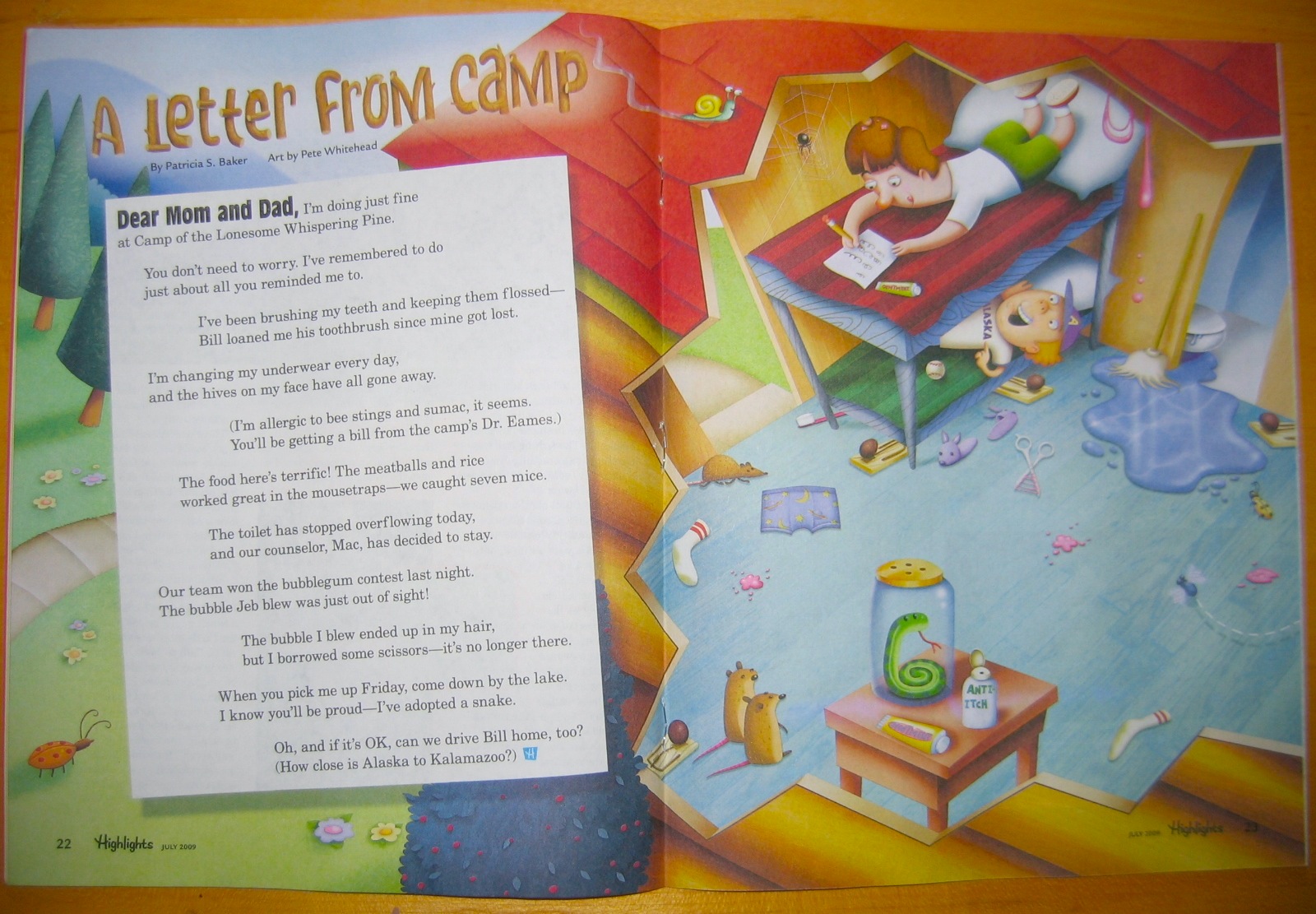
First printed in Highlights for Children, July 2009.
i handed out ten copies,
then broke out in coldest sweat;
how could i let them read these words—
i was no poet yet.
i can’t remember what was said
as they critiqued my poem;
but i could’ve kissed that guy who asked
if he could take it home.
©2006 by Patricia S. Baker
First printed in Writer’s Journal, (Nov/Dec 2006)
THE CHALICE
Those who would follow their Shepherd of love
must learn to drink of the cup from above.
Whether bitter or sweet, to sip of His wine
is to drink with a King from
a chalice divine.
The purest
of potion
from
choicest
of vine
is poured for me daily
from hands pierced for mine.
Today’s Scripture: Genesis 35:6-10
Today’s Verse: God said to him, “Your name is Jacob, but you will no longer be called Jacob; your name will be Israel.” So he named him Israel. Genesis 35:10 (NIV)
When we first moved to our present home seven years ago, we quickly began planting trees on our barren acre of property. Situated on a hill, I worried about the constant effect of strong winds on the young trees.
“Shouldn’t we stake the trees?” I asked my husband. With his background in landscape and design, I trusted his judgment in all things requiring a green thumb.
“Don’t worry,” he replied. “The stress of the wind actually makes the trees stronger, encouraging the roots to grow and take hold.”
Many people today believe that the Christian life should be one of smooth sailing. Yet, the winds of trouble actually cause us to grow stronger in our faith. After Jacob wrestled with God, God named him “Israel,” meaning “he who struggles with God and prevails.” The walk of faith is one in which we can persevere through difficulty because God is with us, anchoring our faith and giving us the strength to prevail.
—Patricia S. Baker
“I’ll strengthen thee, help thee, and cause thee to stand,
Upheld by my righteous, omnipotent hand.”
—John Rippon, “How Firm a Foundation”
©2006 by Patricia S. Baker
First printed in The Quiet Hour, (September-November 2006)
(Psalm 46)
BE still my child, come dwell with Me—
I STILL both heart and stormy sea.
Tho’ earth AND mountain fall away
My children KNOW and on Me stay.
I am the One THAT gives them peace;
Tho’ kingdoms fall, I cannot cease.
To Jacob’s house I AM a rod;
Be still and know that I am GOD.
©2006 by Patricia S. Baker
First printed in The Lutheran Journal, (September 2006)
(Psalm 62)
FIND rest, my soul, in God alone,
The REST that comes to those who wait;
For You, O Lord, are a fortress strong—
Mere breath MY humble, low estate.
My heart and SOUL pour out to God
While on my knees IN prayer I groan;
My refuge is this GOD of love—
For hope is from my God ALONE.
©2007 by Patricia S. Baker
First published by The Deronda Review, (Winter 2009)
by Patricia S. Baker
Each year, thousands of aspiring writers flock to writers’ conferences bearing suitcases, manuscripts, and high hopes for enhancing their writing careers. One of them might be you! Given that a considerable emotional and financial investment has been put into this endeavor, how can you optimize your chances for a successful experience? Here are 10 tips.
Find the Right Fit
Carefully research and prayerfully consider which of the many available conferences is a fit for your particular writing genre. Network with writers from your writers’ group who have attended conferences, or visit http://writing.shawguides.com/ for a list of conferences nationwide. Try to choose a conference that schedules critique appointments with editors or agents who are interested in the type of writing you do.
Register Early
Some conferences schedule appointments based on registration number. Attendees who register early are likely to get their first choice of editors, agents, or authors to meet with. The past two years I have been the first registrant simply by visiting a conference Web site early and printing off the registration form, rather than waiting for it to arrive in the mail.
Visit the conference Web site
Not only is browsing the conference Web site helpful in getting a jump on the registration process, but you can glean valuable information to prepare for the conference. Many times the site will have links to market needs or overworked topics. These can influence your decision as to what you’ll present during your appointments. It is also helpful if the site has …
©2005 by Patricia S. Baker
*Excerpt, first printed in Christian Communicator, (February 2006).
Exaggerated is this news we hear
Of villanelle’s untimely, sad demise;
So, poet, now you wipe away that tear.
Though villanelle remains a form quite queer,
Reports of death are only bold-faced lies;
Exaggerated is this news we hear.
Instead we have report to bring you cheer;
One can write a villanelle if wise,
So, poet, now you wipe away that tear.
You still can write the verse you so revere,
Even if it takes a hundred tries;
Exaggerated is this news we hear.
The villanelle in poetry has no peer,
Though one may need to edit and revise;
So, poet, now you wipe away that tear—
Another chance to write this form is here!
And now the truth I guess you can surmise:
Exaggerated is this news we hear,
So, poet, now you wipe away that tear.
©2010 by Patricia S. Baker
First printed in Writers’ Journal, (May/June 2011, Vol. 32, No. 3, p. 50).
by Pat Baker
We buried my Uncle Dan last summer. A World War II veteran, he was buried with full military honor in a solemn yet beautiful ceremony. One of the defining events of his life was his service in the war, and it seemed entirely fitting that his funeral and burial took place Memorial Day weekend. That, at least, made sense, though the events leading up to his death did not, humanly speaking.
Six months earlier, he’d suffered a massive stroke at the nursing home where he lived. It robbed my gentle and articulate uncle of the ability to speak or move, and after a month of unsuccessful therapy, the nursing home resigned itself to simply keeping him as comfortable as possible.
In the months that followed, I struggled to comprehend the sovereign wisdom of a God who apparently had a purpose in this type of existence for my uncle. I struggled, too, in prayer. My uncle and I were close, and I prayed fervently for his recovery–but instead, his miseries increased. He developed bedsores that stubbornly refused to heal, despite the attention of a concerned nursing staff. I thought of the testing of Job, and wondered how God was redeeming this experience in my uncle’s life.
…
The heading of Psalm 57 refers to it as a miktam of David. According to The Jamieson, Fausset, and Brown Commentary, a miktam of David means a secret of David. A closer look at this psalm will reveal some of the secrets concerning prayer during those times when life seems like one big question mark. When nothing David perceived made sense, what gave him assurance and peace concerning God’s sovereign control over all the events of his life? What was the secret of his stability and confidence in the face of daunting circumstances?
God is a Sovereign Refuge. “Have mercy on me, O God, have mercy on me, for in you my soul takes refuge. I will take refuge in the shadow of your wings until the disaster has passed” (Psa. 57:1, NIV). In the face of danger and uncertainty, David fled to the refuge of his God. Even as he hid in the innermost recesses of a cave, he sheltered his soul deep in the shadow of his Father’s wings. But where is this place, and how can we find it?
In the phrase “shadow of your wings,” the word for wings is the word which in the original language also meant skirt, or corner of a garment. These words refer to the …
©2005 by Patricia S. Baker
*Excerpt, first printed in The Breakthrough Intercessor, (Summer 2005, Vol. 26, Number 3, pp. 28-31).